
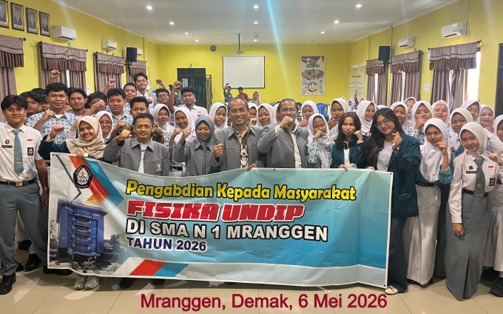
Demak, May 6, 2026 – The Community Service Team from the Physics Study Program at Diponegoro University (UNDIP) conducted an educational initiative titled “Training and Techniques for X-Ray Radiation Hazard Mitigation” at SMA Negeri 1 Mranggen, Demak Regency. Attended by approximately 50 students from grades 10 and 11, the activity aimed to enhance the younger generation’s understanding of X-ray technology, radiation protection, and a culture of radiation safety from an early age.
The initiative was motivated by the ongoing difficulties students face in grasping the fundamental concepts of X-rays, the process of radiation generation, radiation interaction with matter, and the daily application of radiation protection. Furthermore, learning models that tilt toward the purely theoretical often cause radiation-related material to be perceived as abstract and difficult to comprehend.
During the event, the UNDIP Physics team introduced various devices used in the field of radiology, such as X-ray machines, radiation measurement instruments, and personal protective equipment (PPE) like lead aprons. Students also received explanations regarding the benefits of X-rays in healthcare, industry, and security, while simultaneously understanding the risks that can arise if radiation is not utilized in accordance with safety procedures.
The event was opened by the Principal of SMA Negeri 1 Mranggen, Mrs. Puji Ningrum, S.Pd., M.Pd., followed by Zaenal Arifin, M.Si., F.Med., as the chair of the organizing committee. He stated that this activity is part of the university’s efforts to enhance public scientific literacy, particularly regarding radiation technology which is currently widely used across various sectors. “X-rays are an incredibly beneficial technology in healthcare and industry. However, the understanding of its benefits and risks must be delivered in a balanced manner. Through this activity, we want to introduce the basic concepts of X-rays, the utilization of radiological equipment, and the importance of implementing radiation protection principles to the students,” Zaenal remarked.
Following this, Community Service team member Prof. Eko Hidayanto introduced the Physics Study Program and career opportunities in Medical Physics to the participants. Eko also highlighted the research activities and services within the Radiation and Medical Physics Expertise Group, the Medical Physicist Professional Program, and how all three align with the Tridharma pillars: education, research, and community service. On this occasion, the team also introduced the profession of Medical Physicists—professionals responsible for ensuring the safety and quality of radiation use in hospitals, specifically in diagnostic radiology, radiotherapy, and nuclear medicine.
The first instructional session was delivered by Dr. Pandji Triadyaksa, F.Med., who outlined the basic concepts of radiation along with its applications in medicine, industry, and research. He emphasized two core safety principles as the ethical foundation of radiation utilization: justification—meaning every exposure must yield a benefit that outweighs its risk—and optimization—meaning the dose must be kept as low as possible to achieve the objective without compromising safety.
In the subsequent session, Evi Setiawati, M.Si., F.Med., reviewed the hazards of ionizing radiation and its effects on the human body. These effects can be acute or delayed, and are differentiated by the type of cells affected: somatic or genetic. From a protection perspective, she explained the distinction between deterministic effects—which manifest after exceeding a dose threshold and worsen with an increased dose—and stochastic effects, which are random. Evi underlined three practical principles of protection: minimizing exposure time, maximizing distance from the source, and using appropriate shielding, such as lead-lined (Pb) materials. Mitigation steps in the event of a leak or incident were also presented as part of emergency preparedness procedures.
The final session of the event was led by Zaenal Arifin through a simulation of measuring and detecting radiation sources using detectors and survey meters. Participants also practiced using personal protective equipment, including lead-lined aprons, to understand safe working standards in environments with potential radiation exposure. One of the sessions that garnered the most attention was the hands-on practice with survey meters and radiation PPE. Students had the opportunity to try on the lead aprons typically used in radiology installations and observe the working mechanisms of radiation detection tools used by radiation protection officers and medical physicists. “I only just learned that radiation is not always dangerous if it is used according to safety procedures. Practicing with radiation measurement tools was a highly engaging experience,” said one participant.
Throughout the activity, an interactive discussion took place, allowing students to ask direct questions regarding the use of X-rays in medical check-ups, the working principles of radiological equipment, and how to protect oneself from radiation exposure. The community service team also introduced the ALARA (As Low As Reasonably Achievable) principle—the effort to minimize radiation exposure as low as possible without diminishing its beneficial utility. The participants’ enthusiasm was evident throughout the event. Many students expressed interest in radiological technology and development opportunities within Medical Physics, which plays a crucial role in supporting modern healthcare services.
The Principal of SMA Negeri 1 Mranggen welcomed the initiative and appreciated UNDIP Physics’ contribution to providing new insights to the students. “We highly appreciate the community service activity carried out by the UNDIP Physics team. The material delivered is highly relevant to current advancements in science and technology. This event not only broadens our students’ horizons but also raises their awareness regarding the importance of safety in utilizing radiation technology,” stated the Principal.
Through this activity, students are expected to gain a better understanding of X-ray concepts, the benefits and risks of radiation, and the vital importance of a radiation safety culture across various fields. Moving forward, UNDIP Physics remains committed to implementing community service programs that support the advancement of science and technology literacy in society while showcasing the strategic role of Physics and Medical Physics in modern life.
The event concluded with a group photo session featuring the community service team, teachers, and students, symbolizing the collaboration between the university and the school in supporting the quality enhancement of science education in Indonesia.

