

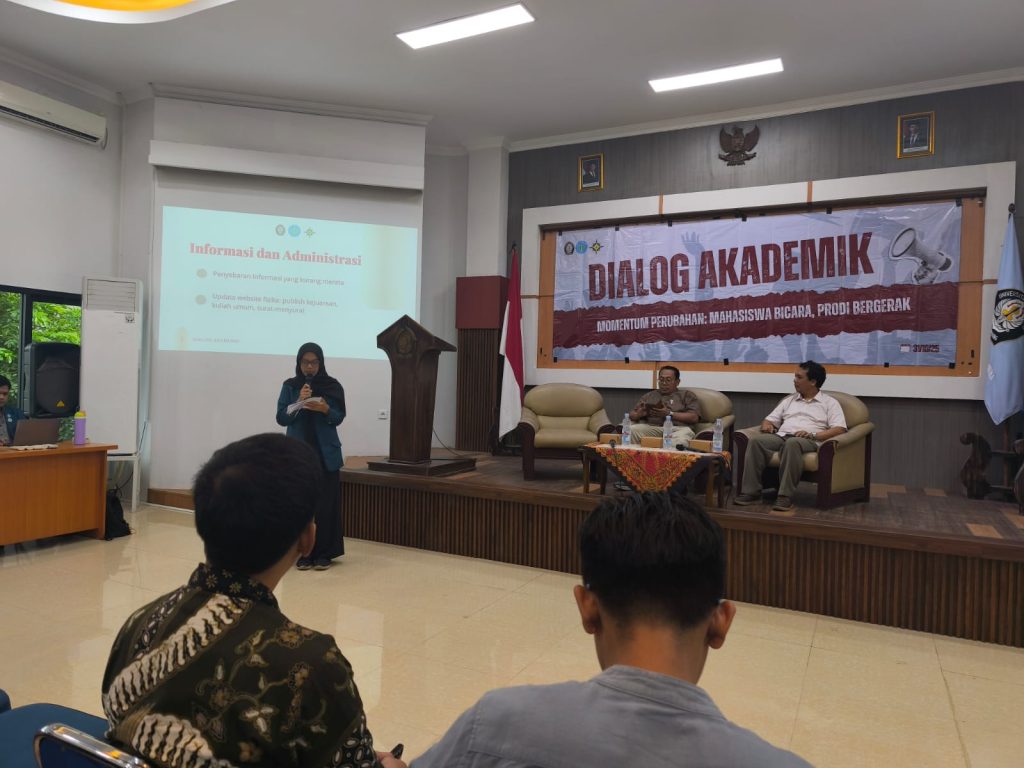
The Department of Physics, Faculty of Science and Mathematics (FSM), Universitas Diponegoro (UNDIP) held an Academic Dialogue on Friday, 14 November 2025, as a Q&A forum to align academic information and respond to recurring student concerns.
On information flow and administrative services, the Department emphasized that updates on student activities (e.g., public lectures and other agendas) will continue to be centralized through the department website, while exam-related information and schedules can be accessed via SSO. In the same forum, the Department also invited students to support website management, noting that the current team is limited and largely handled by lecturers with multiple responsibilities.
A major discussion point concerned examinations and graduation requirements. The Department explained that updates related to the thesis process and comprehensive examinations have begun to be communicated through the Research Methods course (Metopen). The comprehensive exam is currently positioned as a pathway for students pursuing cum laude graduation in line with applicable provisions, while broader implementation for all students is still awaiting further official circulars. Technically, the comprehensive exam is designed to include 100 questions compiled by course lecturers, initially covering General Physics 1 and 2, Mechanics, and Mathematical Physics, with plans to add Thermodynamics and Quantum Physics in a multiple-choice format. The Department also noted that early dissemination was still limited, which affected participation during the initial implementation. For language requirements, the minimum TOEFL scores communicated were 450 (Bachelor’s), 475 (Master’s), and 500 (Doctoral).
Regarding teaching operations and MBKM, the Department stated that the MBKM credit-conversion procedure is available on the Physics website; a 6-month MBKM program may be converted up to 20 credits. However, several core courses cannot be converted because they represent foundational Physics competencies (General Physics 1 and 2, Mechanics, Statistical Physics, and Quantum Physics). The forum also emphasized that conversion opportunities are generally broader for elective courses, and that group submissions are encouraged when converting toward the same target course, while still complying with IRS rules and credit-load limits. For attendance, if an internship is conducted online, students are advised to remain engaged in regular coursework; attendance mechanisms may follow administrative requirements once the MBKM letter is issued. For achievement-based conversion, the Department explained the available options are either course conversion or UKT reduction (students must choose one). For elective-course management, scheduling and lecturer assignment are coordinated by the relevant KBK head, with the note that classes require a minimum number of participants and must consider room availability.
On research and laboratory support, several technical notes were shared regarding practicum readiness and planned improvements. The Millikan apparatus was reported to still be usable at the initial stage but requires follow-up repair/replacement, while the interferometer will be checked for lens compatibility and may be redirected for diffraction practicum if needed. The Department also noted the availability of new grant-supported equipment to replace damaged instruments, including devices related to beta radiation, dual gamma, and an X-ray diffractometer that can support absorption studies for nanomaterials. In addition, the Department conveyed plans to reintroduce the Solid-State Physics practicum, while reiterating that practicum equipment is not intended as a “training” facility for thesis work.
Topics on internships and practical work (KP/PKL) were also discussed to clarify expectations and implementation. KP was reaffirmed as an elective course and is recommended to be carried out during non-lecture days to avoid conflicts with active coursework, with the formal KP guideline expected to be issued soon. The KP submission process will involve a review stage, referencing a load of 2 credits and a structured total-hour plan (including an implementation plan of approximately 20 working days at 4–5 hours per day). PKL, meanwhile, was conveyed as a mandatory course, with semester arrangements following the odd/even NIM policy.
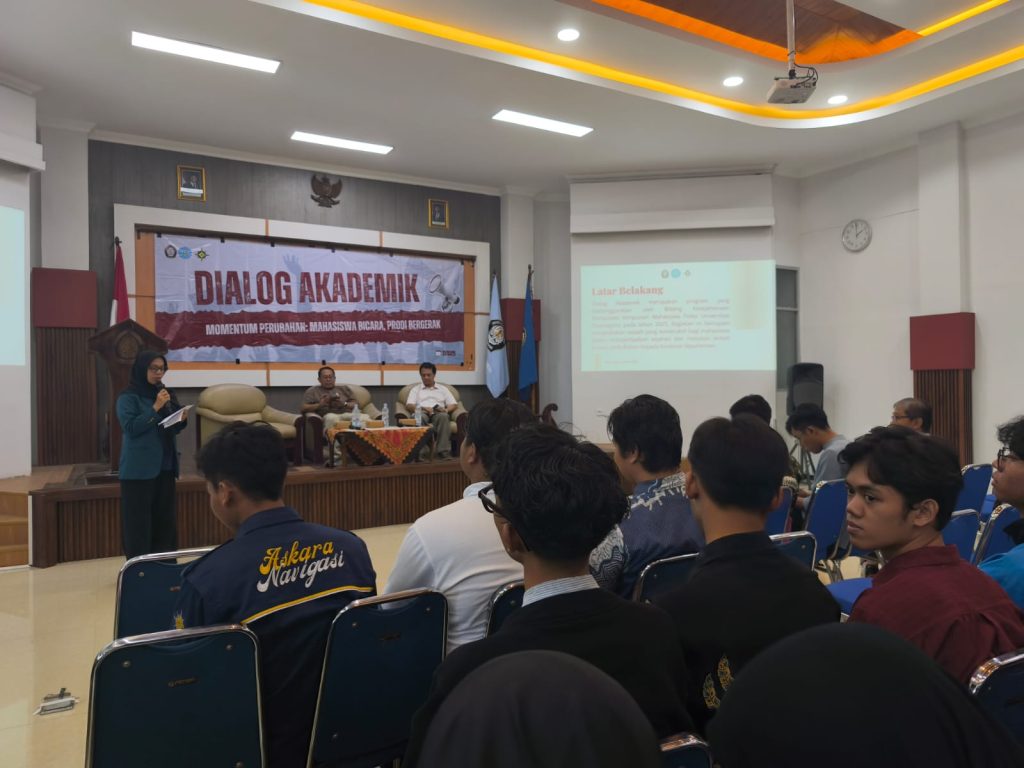
During the Q&A session, several operational needs were addressed, including the potential recognition of the department website management team as an MBKM institutional activity for semesters 4–6, and basic facility support such as computers/printers to streamline student-organization administration. Regarding internships with schedules set unilaterally by partners, the Department explained that dispensations depend on minimum attendance requirements and the discretion of course lecturers, and that MBKM may serve as an alternative route that can also be integrated with thesis work.
The forum also captured broader input related to practicum consistency, updated modules/guidelines, website stability for thesis services, lecturer supervision capacity, as well as improvements to Wi-Fi quality and follow-ups on building renovation. Concerning the deactivation of the HMF website, the Department encouraged formal letter-based coordination and escalation to the faculty level to support investigation and resolution.
Through the Academic Dialogue 2025, the Department reaffirmed a work direction grounded in clearer information, stronger academic services, and gradual, measurable improvements to the practicum and research ecosystem.