
Twin suns? Yes—not only twins; sometimes the real Sun appears flanked by two other “suns.” Why can this happen? It is a natural phenomenon and quite common. Internationally, these companion “suns” are called sundogs. A sundog is not a second and/or third Sun. It is a bright optical spot formed when sunlight passes through tiny hexagonal ice crystals suspended high in the atmosphere. These fine ice crystals are typically found in cirrus or cirrostratus clouds at altitudes of about 6–12 km.
The ice crystals act like millions of small prisms. Sunlight enters one face of a crystal and is refracted (bent) by about 22°. The light exits through another face, creating bright spots on both sides of the Sun. Because this refraction angle is relatively fixed, sundogs appear at the same elevation as the Sun—about 22° to the left and/or right. They often look like two bright “suns” flanking the actual Sun.
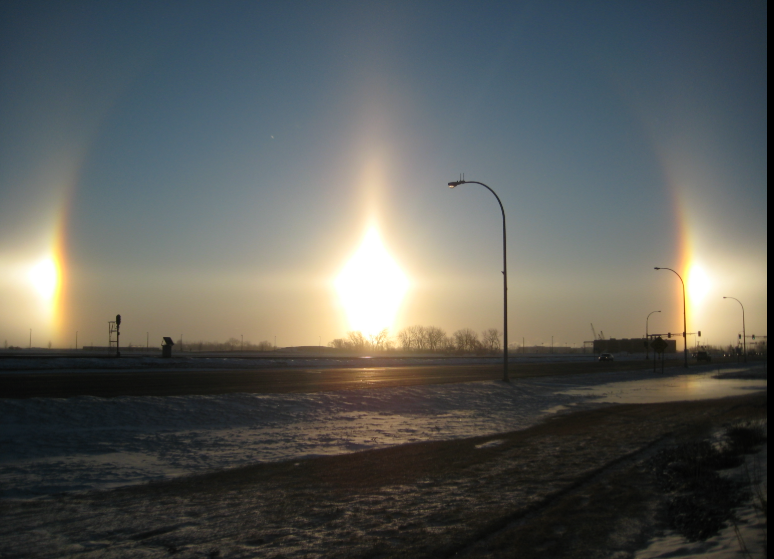
Why are sundogs most visible at sunset or sunrise? Sundogs are much easier to see when the Sun is low in the sky. This is because the light path through the atmosphere is longer. More aligned ice crystals are encountered along the path, making the optical conditions more favorable.
At both sunrise and sunset, the brightness contrast with the sky increases. At sunset, sundogs often appear in golden, orange, or reddish hues, sometimes slightly elongated or blurred. Occasionally, for a brief moment, they can look brighter than the Sun itself. This is why many people first notice them during dramatic sunsets.
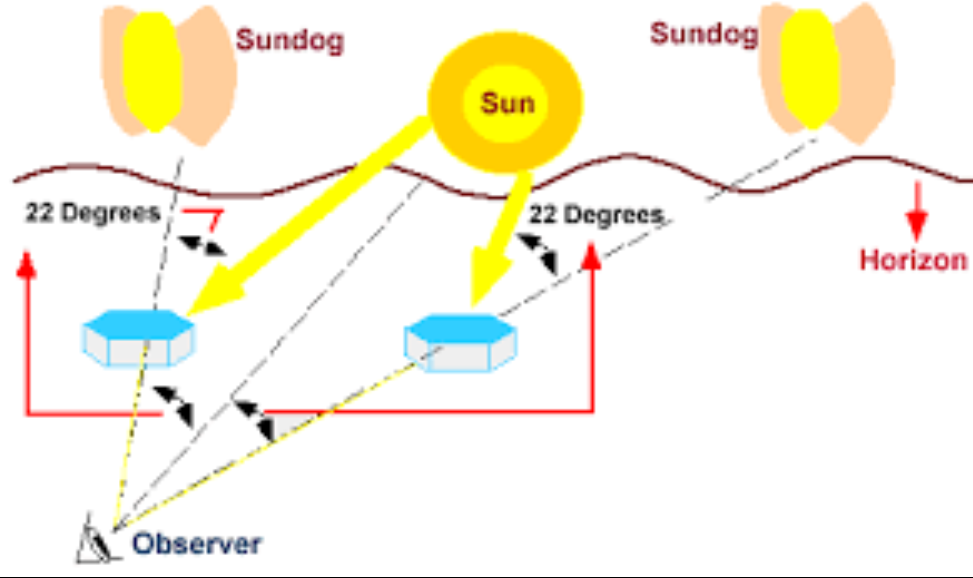
Is this a rare phenomenon? No. It is common, especially in higher latitudes. Sundogs are scientifically well understood and relatively frequent. Even so, lay observers often misinterpret them—attributing them to reflections, camera artifacts, UFOs, “two suns,” or supernatural signs. This phenomenon is very common in cold regions and in high-altitude cloud conditions typical of polar and temperate climates (though it can also occur in the tropics).
Key features for identifying a sundog:
Where can you see a sundog? In our country, if the air is cold and fine hexagonal ice crystals are present in the atmosphere, you might be lucky enough to see a sundog. Look beside the real Sun—do not look above or below it. Yes, the “second Sun” appears to the side of the actual Sun. It only appears when thin clouds exist at a certain altitude. It moves together with the Sun, not independently. The twin suns will disappear when cloud conditions change.